Wappler 8 Has a Unique Opportunity: Bringing Visual Development and AI Agents Together
A developer's perspective on productivity, the future of programming, and what could make Wappler truly stand out.
Hi George, Wappler team, and everyone in the community!
After recently sharing the story of BÜRO-TEC and its journey with Wappler, I've been following the Wappler 8 announcements with great interest.
First of all, congratulations to George and the entire team. The direction you're taking looks very promising. The new Workspaces, Application Map, improvements to project configuration, deployment workflows, PWA capabilities, and the broader vision for managing complete applications all seem like meaningful steps forward.
I also appreciate that you're sharing these developments with the community while they're still being designed, rather than simply presenting a finished product and asking us to adapt to it.
However, there's something I've been thinking about quite a lot lately, and I believe it could be one of the most important opportunities in Wappler's history.
The way we develop software is changing dramatically. And I believe Wappler is in a particularly interesting position to take advantage of that transformation.
I'd like to share my perspective, based on years of professional software development, building commercial applications with Wappler, and more recently, working extensively with AI coding agents.
1. Why I Originally Chose Wappler
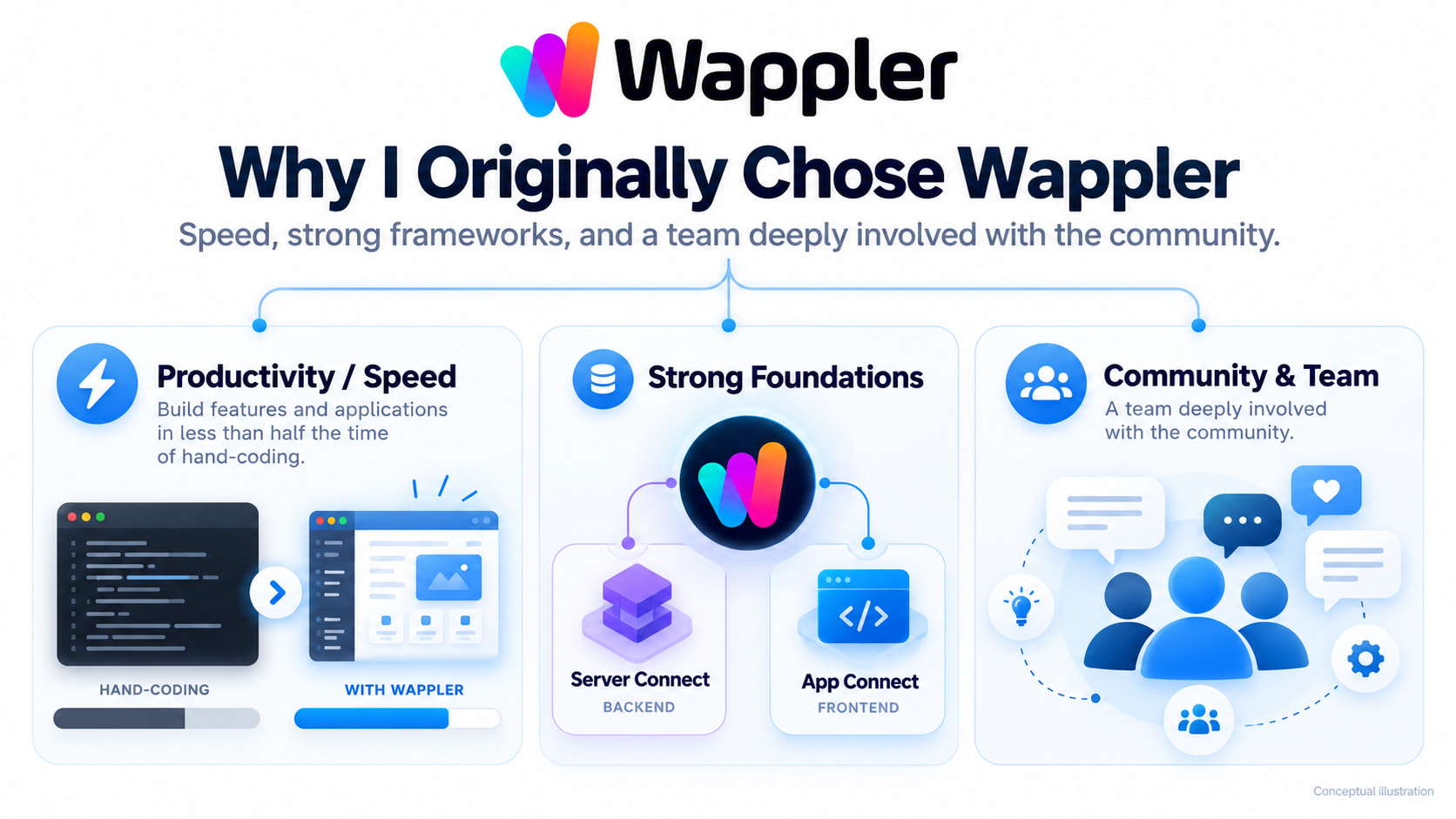
The main reason I chose Wappler was simple: productivity.
At the time, Wappler allowed me to implement features and build applications in less than half the time it would have taken me to write everything manually.
That was an enormous advantage.
But it wasn't just about having a visual interface or avoiding repetitive code.
Two things made Wappler particularly valuable to me: Server Connect and App Connect.
I genuinely considered both frameworks to be solid technological foundations, capable of competing with many alternatives available outside the Wappler ecosystem.
Server Connect provided a structured, practical way to build backend logic, while App Connect made it possible to develop dynamic interfaces without constantly dealing with the repetitive details of traditional frontend development.
Combined with the visual tools, these frameworks created something powerful: an environment where I could focus more on building functionality and less on the mechanics of writing code.
There was also another factor that mattered enormously to me.
George and his team.
Having the founder and the actual developers actively involved in the community, answering questions, discussing ideas, addressing problems, and interacting directly with users is something I have always valued.
And I still do.
That level of involvement is not common in software companies, particularly as their products become more established.
I think it's one of Wappler's greatest strengths, and something worth preserving as the platform evolves.
2. The Real Challenges of Working with a Visual Development Platform
Of course, no development tool is perfect.
One of the frustrations I've experienced over the years has been having to wait for certain bugs to be fixed or for libraries and dependencies to be updated.
When you're developing a commercial application, these delays can become particularly frustrating.
Sometimes you know exactly what needs to be done. Sometimes you even understand the underlying problem. But resolving it properly requires changes within the platform or its frameworks.
And until those changes arrive, you may have to implement workarounds, postpone functionality, or adapt your development process.
This creates an interesting contradiction.
You originally choose a tool because it allows you to develop faster, but sometimes the tool itself becomes the reason you can't move forward at the speed you want.
I understand perfectly well that maintaining something as complex as Wappler is difficult, especially with a relatively small team.
And I recognize the enormous amount of work that goes into maintaining compatibility while introducing new features.
Still, I believe this is an important area to address in Wappler 8.
A modern development platform should not only make it easier to create functionality. It should also reduce the situations where developers become dependent on waiting for the platform itself to evolve.
Ideally, developers should have more control over dependencies, compatibility, updates, and the ability to resolve specific issues without risking future conflicts with generated files.
3. AI Agents Are Changing the Way We Build Software

This is where I believe things become particularly interesting.
Over the past several months, I've been experimenting extensively with AI coding agents and different development workflows.
And the biggest change I've experienced isn't simply that AI can write code.
We've had tools capable of generating code for quite some time.
The real transformation is that I no longer have to concentrate on one small development task at a time.
Instead, I can approach a project from a much broader perspective.
I can define a complete feature, create a detailed implementation plan, break it into phases, and have specialized agents work on different parts of the application.
Frontend, backend, database modifications, testing, refactoring, documentation: these tasks can be organized into coordinated workflows, with some running independently or in parallel when appropriate.
My role increasingly becomes one of planning, reviewing, making architectural decisions, validating results, and ensuring that all the pieces work together.
In other words, I can spend much more time thinking about the application as a whole rather than concentrating exclusively on individual implementation details.
For an experienced developer, I find this change incredibly valuable.
It doesn't eliminate the need to understand programming. Quite the opposite.
Good architecture, technical knowledge, careful planning, and the ability to evaluate what an agent produces are more important than ever.
But the mechanics of development are changing.
And I believe the tools we use need to evolve accordingly.
4. The Opportunity: Wappler as a Truly Agentic Development Environment
I've read the Wappler 8 roadmap, including the proposed AI-assisted workflows, generators, application starters, validation tools, and integration with the existing visual editors.
I think these are positive developments.
But personally, I'd love to see Wappler go considerably further.
What if Wappler became a complete AI-agent development environment, while preserving everything that makes its visual tools so useful?
Imagine opening a project and describing a complete feature in natural language.
For example:
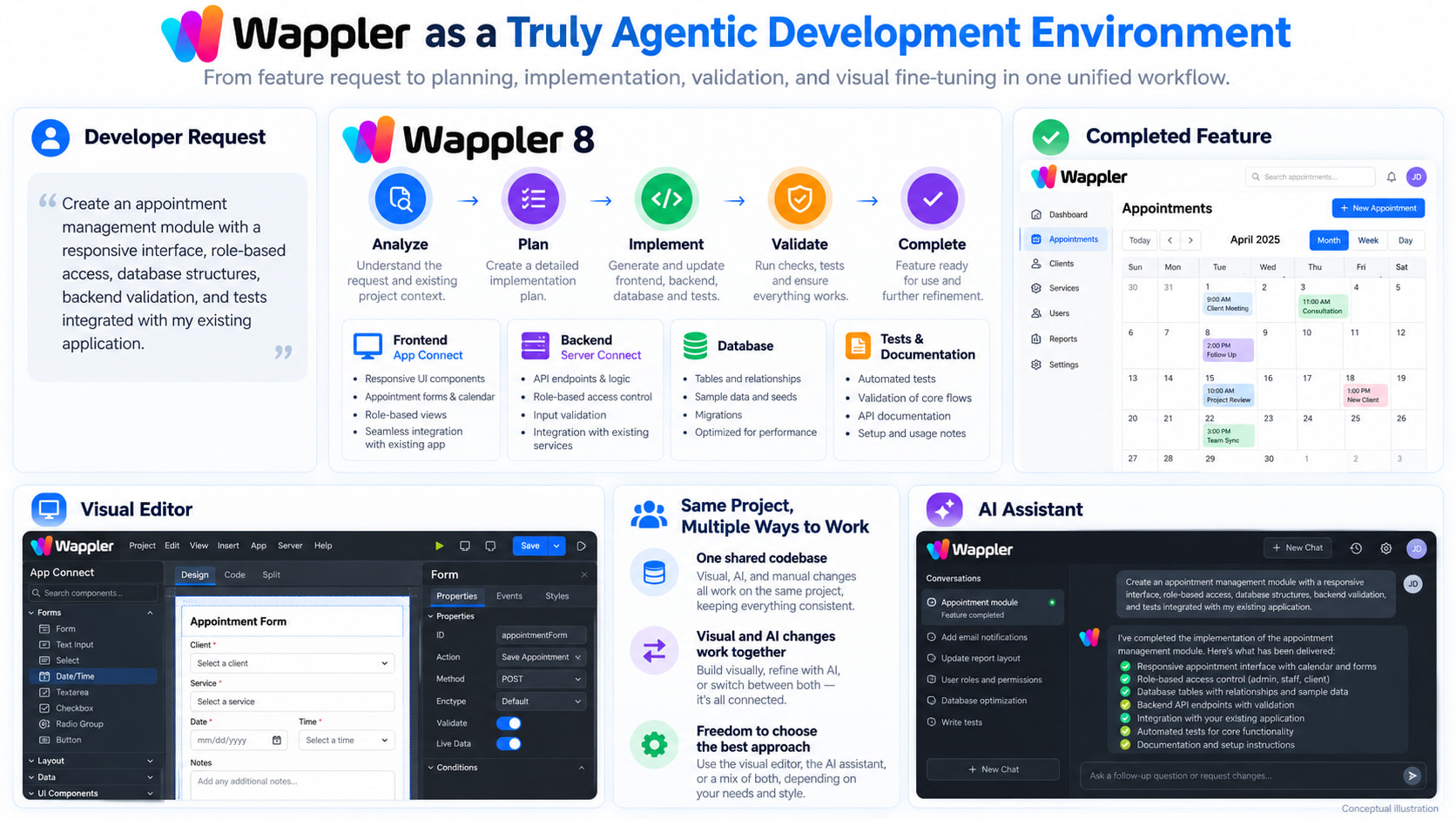
"Create an appointment management module with a responsive interface, role-based access, the necessary database structures, backend validation, automated tests, and integration with the existing application."
Instead of just producing a form or generating some initial code, Wappler could use an agentic workflow to:
-
Analyze the existing application and its architecture.
-
Create a detailed implementation plan.
-
Identify the affected frontend, backend, and database components.
-
Implement the changes across the project.
-
Reuse existing App Connect and Server Connect structures wherever appropriate.
-
Execute validations and tests.
-
Detect errors and attempt to resolve them.
-
Present a clear summary of what was modified.
-
Allow the developer to review, adjust, and approve the result.
And perhaps even more importantly, this workflow shouldn't necessarily stop after a single task.
I'd love to see support for more autonomous, multi-step execution, with appropriate safeguards, checkpoints, and developer supervision.
The objective wouldn't be to remove control from the developer.
It would be to eliminate unnecessary manual work while giving the developer more control over the overall result.
For me, that's the difference between an application with some AI features and a genuinely AI-native development environment.
5. But Please, Don't Lose the Visual Development Experience!
Here's where I think Wappler has an advantage that shouldn't be underestimated.
I genuinely believe that visual development and AI agents could complement each other exceptionally well.
Sometimes, asking an AI to implement a complex feature is exactly what I want.
But other times, I just want to change something small.
Maybe adjust a margin, modify a property, change a color, move an element, or update a particular setting.
Do I really need to write another prompt for every small adjustment?
Of course not.
Sometimes clicking an element and changing its properties directly is simply faster, easier, and more intuitive.
And this is precisely where Wappler could differentiate itself from development environments centered almost entirely around AI conversations and code editing.
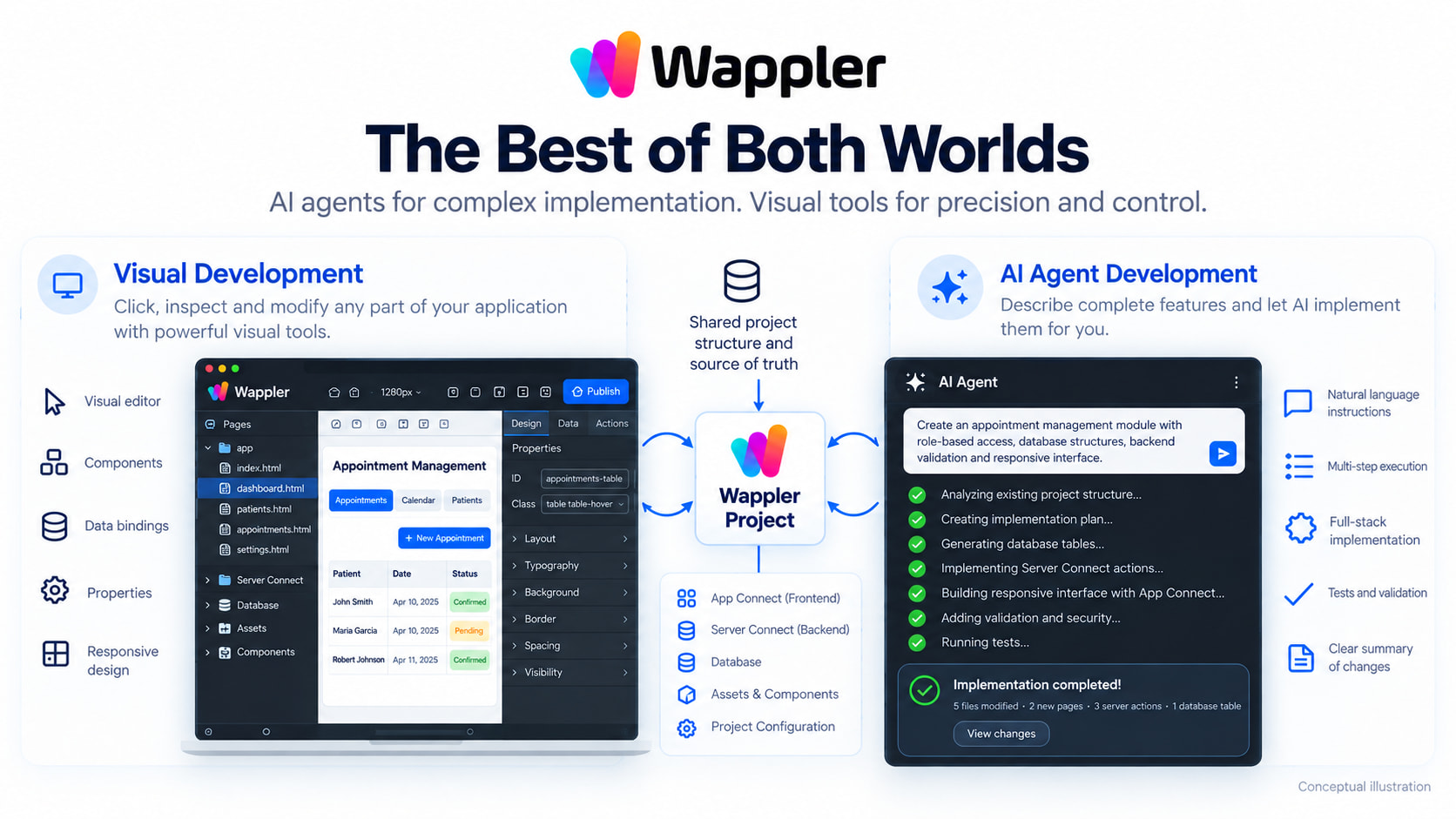
Imagine a workflow where AI agents handle the heavy implementation work, while the developer can instantly switch to a visual interface to inspect and modify the result.
No unnecessary prompts.
No complicated context explanations for trivial adjustments.
No need to choose between visual development and agent-based development.
Both approaches should work on the same project, using the same underlying source of truth.
An agent could create a complete interface, and I could immediately open it in Wappler's visual editor to fine-tune individual components.
Or I could create something visually, then ask an agent to expand its functionality, optimize it, or connect it to backend services.
And, naturally, direct code editing should remain available as well.
The crucial requirement is that these approaches coexist reliably.
Changes made by agents or external tools should be recognized by Wappler, and the visual editor shouldn't unexpectedly overwrite them.
Likewise, agent-generated changes should preserve the integrity of the project's existing visual structures.
I believe achieving this kind of bidirectional interoperability would make Wappler extremely attractive.
It wouldn't just be another AI-powered IDE.
It would offer a genuinely different development experience.
6. A First-Class CLI Could Be One of Wappler's Most Important Features
This is something I've mentioned before, and I think it's even more relevant today.
I would really like Wappler to have its own proper CLI.
Not simply an embedded terminal, but a complete command-line interface exposing Wappler's development capabilities.
Why?
Because modern development increasingly involves automation, scripts, external agents, multiple terminal sessions, and workflows that don't necessarily begin inside a graphical application.
Imagine being able to interact with Wappler projects from a terminal:
-
Inspect project structures, routes, and dependencies.
-
Create or modify Server Connect actions.
-
Access project metadata and available components.
-
Validate generated structures and configuration.
-
Execute tests and development tasks.
-
Manage environments and deployment operations.
-
Run well-defined actions without opening the desktop interface.
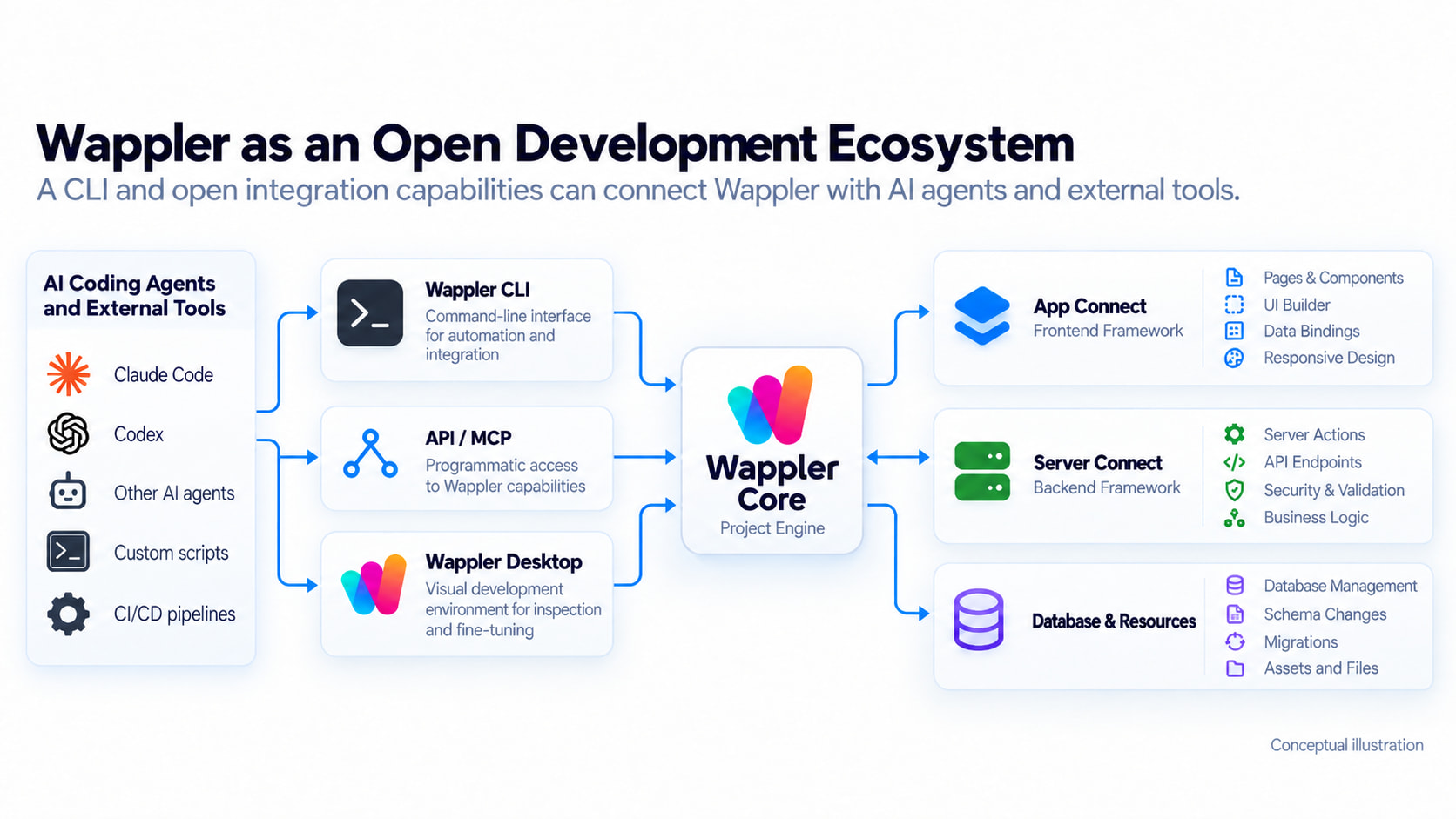
This could also provide a foundation for integrating Wappler with existing AI coding tools.
Rather than expecting developers to abandon their preferred agents, Wappler could expose its own capabilities through a CLI, an API, or a protocol such as MCP.
That would allow external tools to understand and interact with Wappler projects more reliably, using supported operations rather than attempting to reverse-engineer project structures.
And it could enable a much broader automation ecosystem.
Imagine running an agent in one terminal while keeping Wappler open as a visual development and inspection environment.
The agent makes changes, Wappler recognizes them, and the developer can immediately inspect or adjust the results.
For me, that would be a remarkable combination.
Of course, operations capable of modifying databases, deleting resources, or deploying applications would need explicit permissions and appropriate safeguards.
But the architectural potential is enormous.
I strongly believe a first-class CLI should be considered a fundamental part of Wappler's future, not merely an optional convenience.
7. Wappler 8's New Direction Looks Very Promising
I also want to emphasize that I genuinely like what I've seen so far.
The new Activity Workspaces and Application Map look particularly interesting.
Being able to understand relationships between pages, routes, APIs, and server actions from a more global perspective fits very well with the way I believe modern development should work.
The proposed improvements to project configuration and deployment also make sense.
Having a clearer, more unified understanding of development, staging, and production environments could eliminate many unnecessary steps and configuration mistakes.
I'm also particularly pleased to see the attention being given to PWAs.
For many business applications, a well-designed PWA can deliver an excellent experience across desktop and mobile platforms without requiring completely separate applications.
And the Solutions concept, bringing together related frontend, backend, web, and mobile projects, seems like another sensible evolution.
However, I think the true value of all these improvements will depend on how well they scale to complex applications.
An Application Map that works beautifully with a small demo is one thing.
An Application Map that remains responsive, useful, and easy to navigate when dealing with hundreds of pages, APIs, and interconnected components is something much more valuable.
I would love to see Wappler 8 demonstrated and tested against genuinely large, long-lived commercial projects.
That's where the benefits of these architectural improvements could become especially meaningful.
8. Performance and Resource Consumption Must Be a Priority
Another important point is performance.
In my experience, Wappler can become noticeably slower and consume considerable resources when working with large repositories and complex applications.
That can affect the development experience significantly.
When you're working for several hours, responsiveness matters.
Opening files, navigating project structures, editing components, switching between views, and executing common operations should remain fluid.
I was glad to read that the Wappler 8 team is investing in performance improvements, background indexing, and a revised desktop architecture.
I think that's absolutely the right direction.
One possibility worth exploring, perhaps for the longer term, is whether technologies such as Rust or Tauri could help reduce resource consumption in certain parts of the application.
I'm aware that Wappler 8 is already undergoing a major architectural rewrite, and I wouldn't suggest changing the technology stack purely because another language or framework is fashionable.
Architecture decisions should be supported by real benchmarks and long-term maintenance considerations.
But I do think memory usage, CPU consumption, startup performance, and responsiveness on large projects deserve explicit, measurable targets.
A powerful development environment shouldn't require increasingly powerful hardware just to remain comfortable to use.
And as AI agents become part of everyday development, resource efficiency becomes even more important because several processes may be running simultaneously.
I'd love to see performance become one of the defining strengths of Wappler 8.
9. Reliability, Updates, and the Importance of Maintaining What Already Works
There's another point I consider essential.
Innovation is exciting, but reliability is what allows us to depend on a development platform professionally.
When a bug interferes with a production project, waiting for a fix can have consequences far beyond the inconvenience of using the editor.
It can delay deliveries, prevent features from being implemented, and increase maintenance costs.
The same applies to libraries and dependencies.
If an application requires an updated library for security, compatibility, or functionality, developers need a predictable way to manage that evolution.
I think Wappler 8 would benefit greatly from clearer processes for reporting and tracking bugs, communicating priorities, and maintaining compatibility.
A few ideas I would particularly appreciate are transparent issue tracking, better visibility into planned fixes, project-level dependency management, and more straightforward ways to validate updates before applying them.
AI could even contribute here by helping analyze bug reports, identify reproducible cases, suggest corrections, and execute regression tests.
This could be especially useful for a small development team maintaining a platform with so many interconnected technologies.
And I believe the community could play an important role in that process.
I don't think Wappler should stop innovating to focus exclusively on maintenance.
But new features and reliability shouldn't be competing priorities.
They are both essential parts of a professional development platform.
10. The Question of Value in a Changing Market
I'd also like to bring up a practical consideration: pricing.
I understand that developing and maintaining Wappler involves significant work, and I'm not suggesting that a product with this level of complexity should be inexpensive.
However, the market around development tools is changing very quickly.
From my perspective, a subscription costing around $60 per month now competes for the same budget as several very capable AI development tools and subscriptions.
And that naturally changes how developers evaluate value.
Today, the question is no longer simply whether a tool saves time compared with writing code manually.
It's also whether it provides meaningful advantages over working with powerful AI coding agents.
That's why I believe Wappler's future value proposition should be extremely clear.
If Wappler can combine autonomous AI development with the precision and convenience of its visual tools, it could offer something that many other development environments don't.
And that would be a compelling reason to invest in the platform.
I don't believe the answer is necessarily to compete on price alone.
I believe it's to deliver a development experience that justifies the investment through real productivity gains.
11. My Vision for Wappler's Future
If I had to summarize everything I've written in one idea, it would be this:
Wappler's next major opportunity isn't just to make visual development better. It's to make visual development and agent-driven development work together as one seamless experience.
I believe the future of software development will increasingly involve developers supervising and orchestrating multiple intelligent agents, while retaining the ability to intervene directly whenever necessary.
Sometimes we'll work through detailed plans and autonomous workflows.
Sometimes we'll write code ourselves.
And sometimes we'll simply want to click a component and change a property.
A truly modern development environment should allow us to move naturally between all three.
Wappler already has important foundations that could make this possible.
It has its own frontend and backend frameworks, structured project metadata, visual editors, database tools, application management capabilities, and years of experience helping developers build real commercial applications.
And, perhaps most importantly, it has a team that understands the value of working closely with its community.
I don't think Wappler needs to abandon its identity to adapt to the age of AI.
Quite the opposite.
Its visual identity could become one of its greatest competitive advantages, provided that AI becomes a fundamental part of how applications are built, rather than just another feature inside the interface.
The goal shouldn't be to force developers to choose between clicking, coding, and prompting.
The goal should be to let us use whichever approach is most effective at any given moment.
12. Final Thoughts
I understand that Wappler 8 is a major undertaking, and that many of the features we've seen are still being designed or developed.
I certainly don't expect every idea discussed here to become part of the first release.
But I do believe this is an important moment to think beyond individual features and consider what the overall development experience should look like over the next several years.
My three biggest wishes would be:
-
Truly agentic AI capabilities, able to plan, implement, test, and modify complete application features with meaningful developer oversight.
-
A seamless combination of AI, visual editing, and traditional coding, where all three approaches can work reliably on the same project.
-
A first-class CLI and open integration capabilities, supported by excellent performance, stability, and predictable dependency management.
If Wappler can move convincingly in that direction, I think it could occupy a very interesting position in the development tools market.
Not simply as another visual builder.
Not simply as another AI coding environment.
But as a platform that successfully combines the strengths of both worlds.
And personally, I find that possibility very exciting.
Thank you, George, Teodor, Patrick, and everyone involved in Wappler, for continuing to push the platform forward and for giving the community an opportunity to contribute to its future.
I'm genuinely looking forward to seeing how Wappler 8 evolves, and I'd love to hear what the rest of the community thinks about this direction.
The future of development isn't about choosing between human control and AI automation. It's about finding the best way to combine them.
Cheers!

