From a Small Medical Appointment App to Over 4,000 Healthcare Professionals: My Journey with Wappler and BÜRO-TEC
Hi everyone!
I've been part of this community for several years now, and strangely enough, I've never taken the time to share a real world example of an application I've built with Wappler.
Now that I'm working in a new release version 9 of BÜRO-TEC, I thought this would be a good opportunity to share its story. Not just because it's a project I've grown very attached to, but because I think it's a great example of what can be achieved with Wappler when a development tool becomes part of a long term commercial project. 
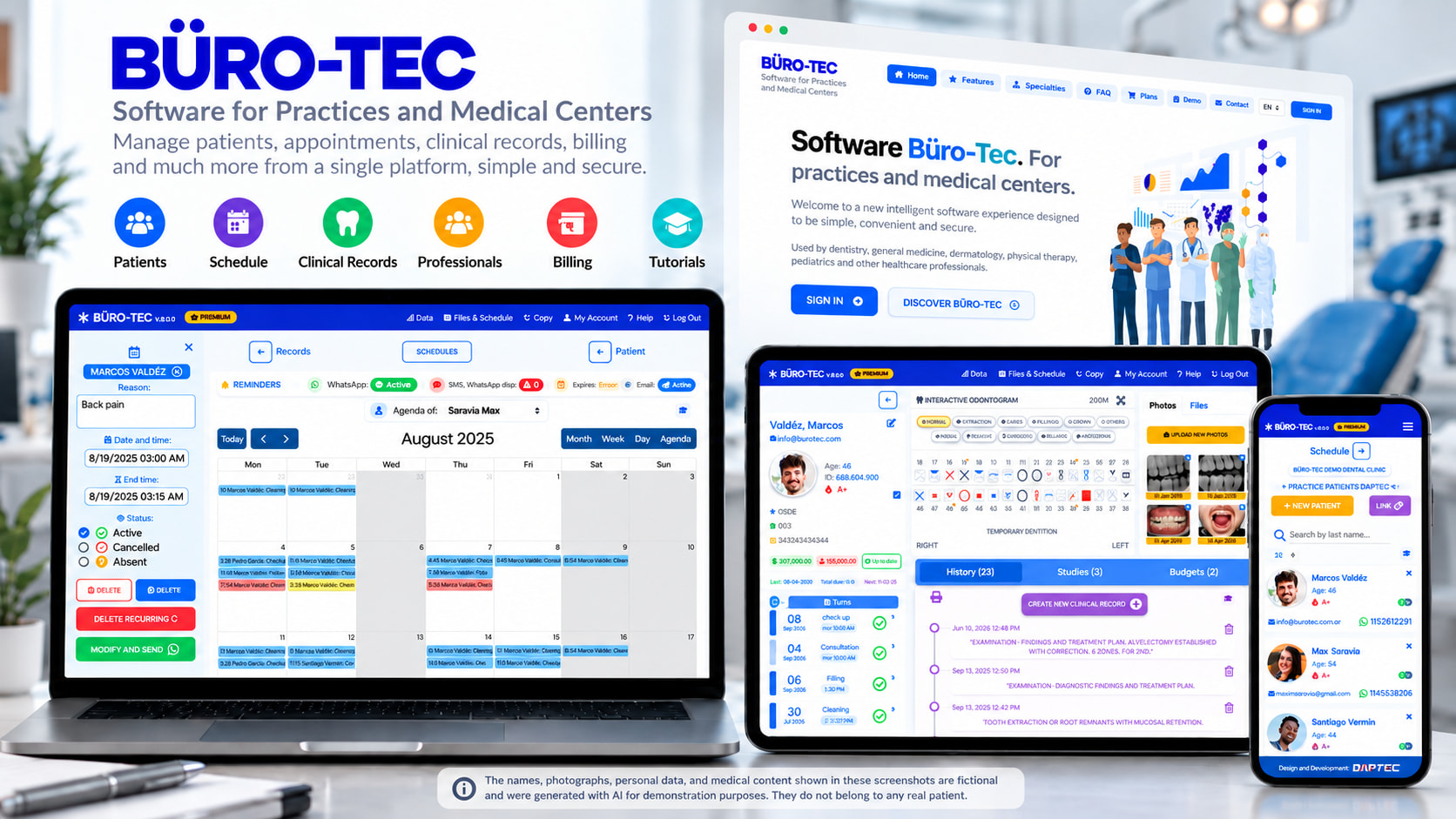
Today, BÜRO-TEC is a SaaS platform for managing medical practices and healthcare centers, used by more than 4,000 healthcare professionals.
But the story started long before Wappler even existed.
It All Started in 2005, with Macromedia Dreamweaver
Back in 2005, I started developing a small application to help a family member who needed a way to organize appointments and patient records.
There was no business plan, no commercial strategy, and certainly no intention of building a SaaS product. I simply wanted to solve a specific problem.
The first version was built with Macromedia Dreamweaver, back when it wasn't owned by Adobe yet, using classic ASP (Active Server Pages).
It was pretty simple: an appointment calendar and a basic patient records system.
Over time, some friends who worked in healthcare became interested in the application and started asking if they could use it too.
And that's how it began to grow.
First came recurring appointments, then appointment reservations, new patient management features, and various tools that emerged from the actual needs of the people using it.
Before I really noticed, that little application I'd built for one person was slowly becoming a product.
The CakePHP Years
When Dreamweaver started losing the features that made it useful for developing dynamic applications, I decided it was time for a major change. I migrated the entire application from ASP to PHP, rebuilding it from scratch using CakePHP.
And I have to admit, I loved it.
It was an elegant, practical, relatively simple framework that did exactly what I needed without too much unnecessary complexity.
Over the years, more popular and sophisticated alternatives appeared, but I always had a soft spot for CakePHP.
At the same time, I was also developing applications with Ruby on Rails, another framework I really enjoyed and used for several projects.
More than once, I was tempted to migrate my little medical application to Rails.
But there were two reasons I never did.
The first was that I'd grown attached to the project. It was one of those applications you keep maintaining and improving over the years, without too much pressure.
The second was that, strangely enough, I actually enjoyed going back to CakePHP from time to time. It was a nice change from my regular work.
Back then, the application had no more than 20 users, so there wasn't much of a reason to make any major changes anyway.
The Road to Wappler
During those years, I also considered going back to Dreamweaver several times, using the DMXzone extensions.
I knew I could develop certain features much faster, but two things held me back.
First, I had honestly become pretty disappointed with Adobe and what it had done to Dreamweaver.
Second, I thought the DMXzone extensions were quite expensive.
No offense, George. I just thought they were a bit pricey back then! 
Meanwhile, I was still writing a ton of code by hand on other projects, and depending on their size, I sometimes had to hire additional developers to help move things along.
So I started looking for a low-code tool that would allow me to build real, complex, commercial web applications faster, without giving up control over the code.
And that last part was extremely important to me.
I didn't want to depend on a closed platform or get locked into a service I might not be able to leave someday.
Around 2019, I looked into several alternatives. Some were too limited, while others were simply too expensive for what they offered. One of them was Bubble, which, fortunately, I never ended up using.
And then I discovered Wappler.
What immediately caught my attention was that the people behind it were the same developers who had created DMXzone.
But this time, the offering was different.
The price seemed reasonable, the possibilities were huge, and most importantly, I could keep the source code of my applications. 
For me, that made a massive difference.
So I paid for a subscription and decided to give it a try.
But not with a small demo application.
I decided to rebuild my entire medical management system from scratch.
And That's How BÜRO-TEC Was Born

Until then, the application was called Consuldtec.
However, I had received a legal notice from another company that had been using that name before me and held the rights to it.
They were right, so it was time for a name change.
I took the opportunity to give the product a completely new identity.
That's how BÜRO-TEC was born, taking its name from the German word Büro, meaning office, which I associated with a professional's workspace.
And along with the new name came a completely new application, built from scratch with Wappler.
It was my very first project on the platform.
Even though I already had many years of programming experience, I wanted to see for myself whether it was really possible to use a visual development tool to build a serious, scalable, commercial SaaS application.
Over the years, the answer became pretty clear.
From a Handful of Users to Thousands of Professionals

BÜRO-TEC kept growing, adding features and adapting to the real needs of doctors, dentists, and other healthcare professionals.
What started as an appointment calendar eventually became a complete practice management platform.
And a big part of that growth was made possible by Wappler.
Being able to develop new features, modify processes, build interfaces, and connect backend operations much faster allowed me to spend more time improving the product and less time writing repetitive code.
Of course, Wappler isn't magic.
There's a tremendous amount of work behind any commercial application: design, architecture, databases, security, testing, maintenance, customer support, and hundreds of decisions that no development tool can make for you.
But having an environment that speeds up development is a huge advantage, especially when working with small teams.
I also want to highlight something I consider essential: the Wappler community.
Over the years, I've learned a lot from reading discussions, asking questions, and seeing the solutions shared by other developers.
And, of course, there's the work of the Wappler team, who have continuously maintained and improved the platform.
Without their efforts and the contributions of this community, I'm convinced the journey would have been a lot more difficult.
A Nearly Fully Automated Commercial Application
Today, BÜRO-TEC does much more than manage the daily work of thousands of healthcare professionals.
It's also a SaaS business with most of its operations automated.
The platform handles new user registrations, subscriptions, payment processing, expiration reminders, and renewals.
It even takes care of administrative and tax-related processes associated with running the business.
In practice, most of the business can operate without manual intervention.
Naturally, there's always maintenance, support, and improvements to work on. But I no longer need to personally keep track of every new registration, renewal, or administrative operation.
That allows me to focus on developing new features and continuing to improve the user experience.
And there's another detail I'd like to share, especially for those wondering whether an application built with Wappler can actually scale as a commercial product:
BÜRO-TEC currently serves more than 4,000 healthcare professionals and runs on a cloud server with just 12 vCPUs and 32 GB of RAM.
I think that's a good real-world example of how you don't always need massive infrastructure to provide a reliable service to thousands of users. Good architecture, a properly designed database, and a well-optimized application can go a long way.
Some of BÜRO-TEC's Features
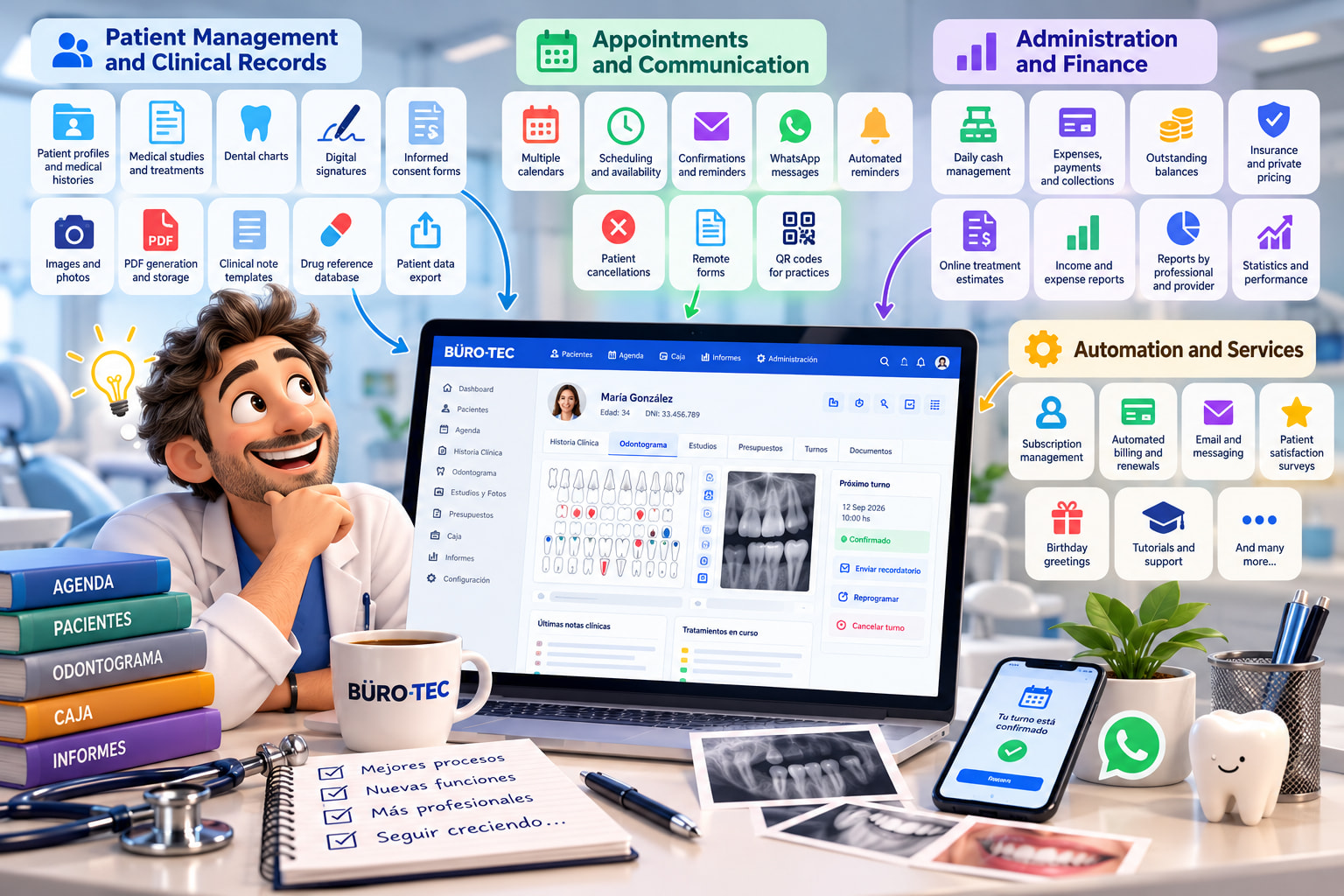
To give you an idea of how far that little appointment calendar from 2005 has come, here are some of the features the platform currently offers:
Patient Management and Clinical Records
-
Complete patient profiles and medical histories.
-
Tracking of medical studies and treatments.
-
Dental charts and specialized tools for dentistry and orthodontics.
-
Electronic document signing for professionals and patients.
-
Informed consent forms.
-
Image capture, storage, and management.
-
PDF document generation and storage.
-
Templates for clinical notes.
-
Integrated drug reference database.
-
Patient data export.
Appointments and Communication
-
Independent appointment calendars for each professional.
-
Appointment scheduling and availability management.
-
Appointment confirmations and reminders via email and WhatsApp.
-
Automated appointment reminders.
-
Patient-initiated appointment cancellations.
-
Forms that patients can complete remotely.
-
Personalized QR codes for medical practices.
Administration and Finance
-
Daily cash management.
-
Expense, payment, and collection tracking.
-
Patient outstanding balance management.
-
Pricing management for health insurance providers and private patients.
-
Treatment estimates that patients can accept or reject directly from their phones.
-
Income, transaction, and expense reports.
-
Reports by professional and insurance provider.
-
Statistics and performance indicators.
Automation and Services
-
Subscription management.
-
Automated billing and renewal processes.
-
Email and messaging communications.
-
Automated patient satisfaction surveys.
-
Birthday greetings.
-
Integrated support tools and tutorials.
And many other features that have been added over the years.
The Website Was Built with Wappler Too
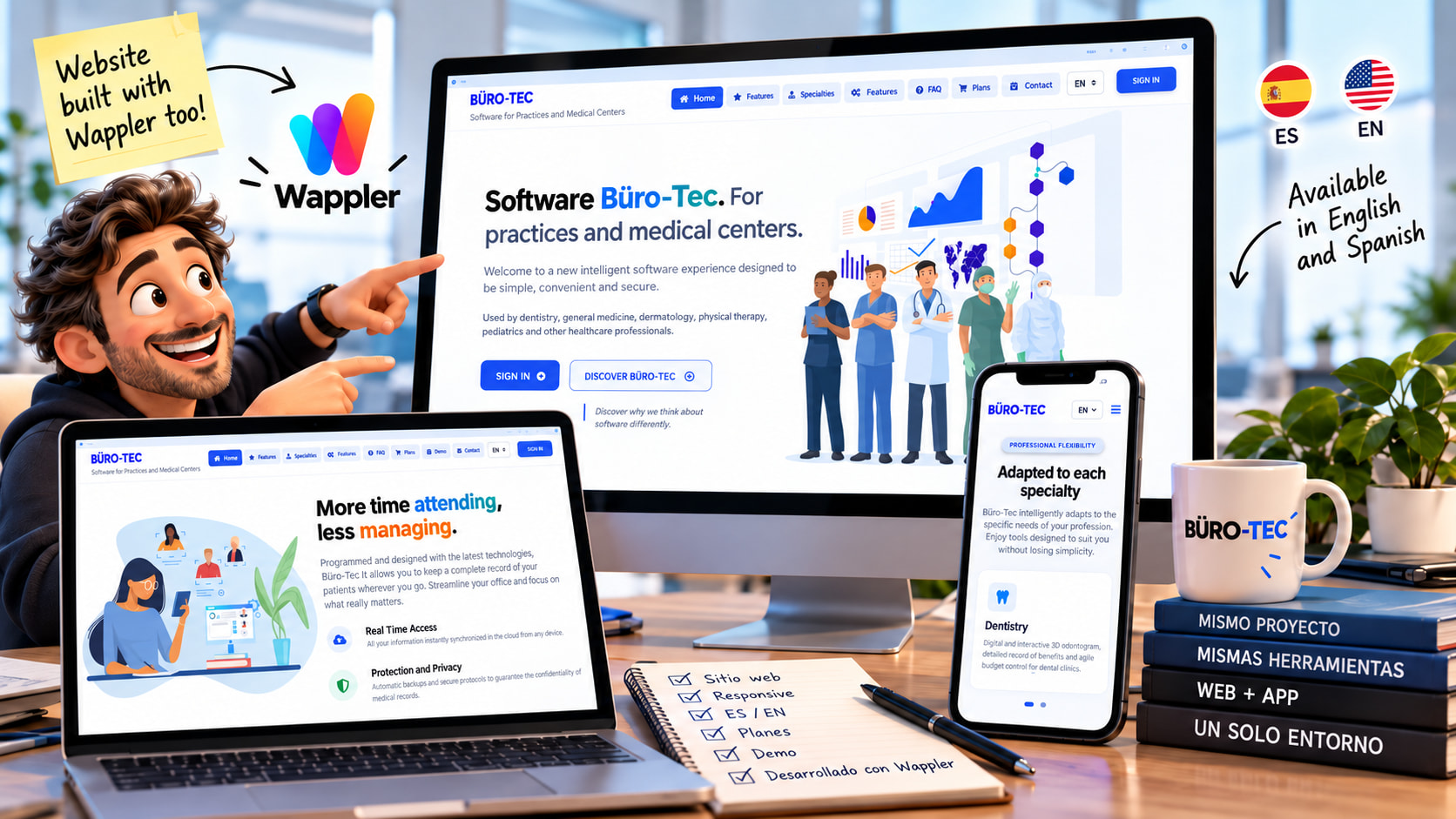
Something else worth mentioning is that BÜRO-TEC's entire public website was also developed with Wappler.
It's not just a simple landing page. It presents the platform's features, supported medical specialties, subscription plans, and product demonstrations, while also serving as an entry point for new customers.
The website is fully responsive, with dedicated layouts for desktop and mobile devices, and is available in both English and Spanish.
Having both the application and its public website developed with Wappler allowed me to manage and evolve the entire product ecosystem within the same development environment.
The Next Chapter: BÜRO-TEC 9
I'm currently working on BÜRO-TEC 9, a new version built with more modern technologies, new features, and numerous improvements to the user experience.
It's exciting to see how that little project I started back in 2005 is still evolving more than twenty years later.
And looking back, it's impossible not to recognize the fundamental role Wappler played in this journey.
Thanks to Wappler, I was able to dramatically speed up development, add features that would previously have taken me much longer, and turn a relatively small application into a commercial product used by thousands of professionals.
Wappler wasn't just a tool I used to develop BÜRO-TEC. It was an important part of its growth.
Final Thoughts
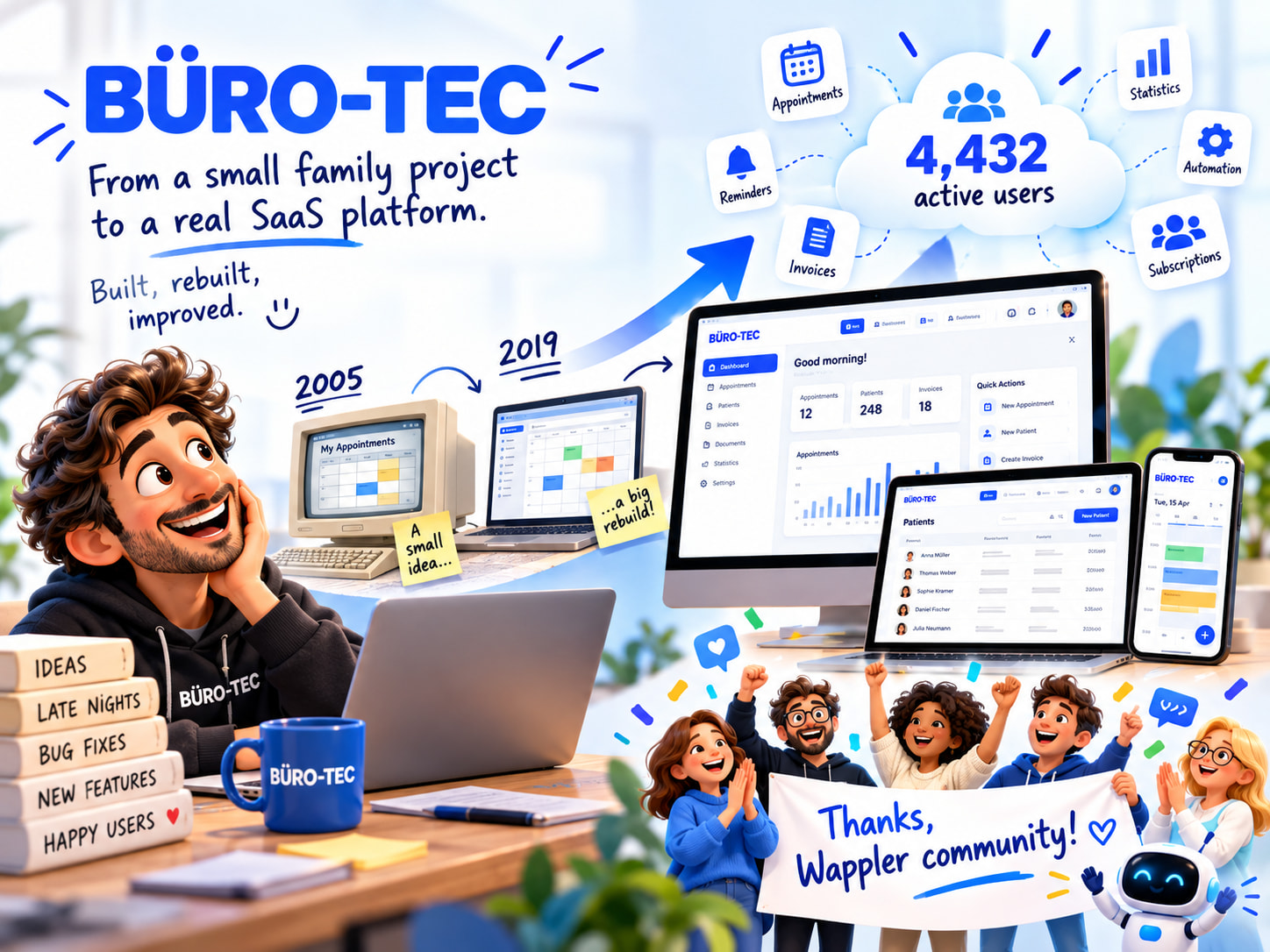
I'm sharing this story because most of the projects I see showcased in this community are just getting started. I thought it would be interesting to share the experience of a project that has been developed, maintained, and continuously improved with Wappler over several years.
My experience with Wappler shows that it's entirely possible to build a SaaS business, grow it, automate most of its operations, and serve thousands of users without needing a huge development team.
None of this happened overnight. There were many years of work, mistakes, decisions, rebuilds, and learning along the way.
If someone had told me back in 2005 that the little appointment application I'd built to help a family member would eventually become a platform used by thousands of healthcare professionals, I probably wouldn't have believed them. In fact, BÜRO-TEC currently has exactly 4,432 active users.
And if someone had told me in 2019 that my first Wappler application would reach that scale, I would have had a hard time imagining that too.
So I'd like to take this opportunity to thank George, the entire Wappler team, and everyone in this community for all the work, ideas, and knowledge shared over the years.
I'm sure there are plenty of developers in this community with similar stories. I'd love to hear them, and I hope this post encourages others to share their projects, especially those they've been working on for years but have never shown here.
One last thing: BÜRO-TEC's website is available in both English and Spanish, although the application itself is currently only available in Spanish, as it's primarily aimed at the Latin American and Spanish markets. After the release of version 9, I'll be working on making the application available in other languages as well.
If you'd like to check out BÜRO-TEC, here's the website:
You can also visit my company's website, DAPTEC, where I showcase some of my work and the technologies I use, including Wappler, which is proudly featured among them.
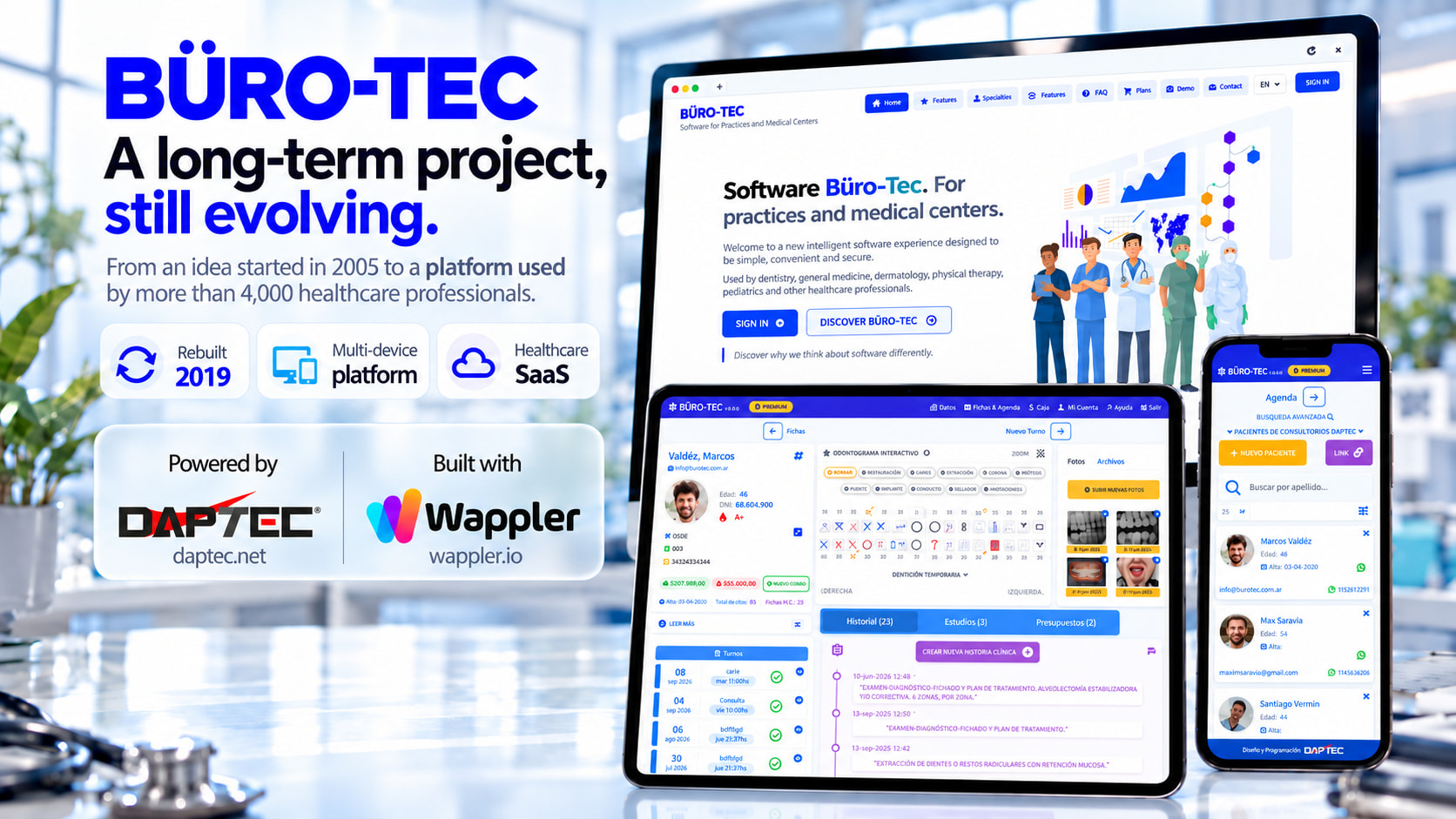


 It's been a long journey, and Wappler has been a huge part of it. Big thanks to you and the whole team for making it possible. Keep up the great work!


